
Writing
Intent:
At Nottingham Academy Primary, our intent is to provide an engaging English curriculum for our children that allows them to develop into confident and creative writers. We do this by immersing children in a curriculum that is tailored to their needs, responsive to the different speeds at which children learn and sensitive to the challenges that all children face on their learning journey.
Having a well-planned, carefully structured, progressive curriculum that runs from the beginning of EYFS to the end of year 6 allows us to have high expectations of all children whilst ensuring that skills and knowledge are taught, practised and embedded throughout our children’s learning journey.
At the heart of this is the intention of all staff here at Nottingham Academy to instil a love of reading, writing and discussion in our children that will have a positive impact on their development during their time here, and a lasting impact on their lives.
Implementation:
English lessons are taught in units that are planned around high-quality, challenging texts. The children are immersed in this engaging narrative (or non-fiction text), over several weeks, exploring characters, settings, storylines and themes. The writing skills developed in these lessons are carefully selected so that they form part of a whole-school skills progression. This allows children to master age-appropriate skills and enables the teachers to provide timely challenge or support where it is needed.
We believe that children’s learning is enhanced when they are writing for a purpose. Because of this, we structure our units in a way that allows teachers and their classes to focus on one key writing purpose at a time – writing to entertain, persuade or inform. This approach means that children spend several weeks gaining a thorough understanding of how to write for a specific purpose and what skills to employ, whether this is writing a story, letter, diary, or leaflet, creating a fact file or recounting an event.
Writers in EYFS and Year 1 use the ‘Fantastic lenses' from ‘The Write stuff’ approach to help focus ideas and thoughts around elements of narratives and non-narratives, including, action, speech, feelings and noticing (observation) as well as using them as hooks to help up-level the vocabulary we learn and develop attached to each of those areas. This focus on high quality vocabulary and purposeful writing continues throughout school.
All children have writing targets
Daily English lessons are structured to include:
- Spag
- Vocabulary
- High quality teacher modelling
- Independent writing
- Editing
- All with a focus on 100% participation from pupils engaged in active learning.
Disciplinary literacy:
At Nottingham Academy, we teach children to write like experts through disciplinary literacy by showing them how to structure and present their ideas in ways that reflect each subject. In science, children are guided to write clear explanations and reports using accurate terminology, while in history they learn to construct well-reasoned arguments supported by evidence from sources. Across the primary curriculum, teachers model expert writing, provide scaffolds such as sentence stems and explicitly teach subject-specific vocabulary so that children can confidently produce texts of each discipline. At the end of each unit, pupils showcase their knowledge through 'show it' pieces, demonstrating their ability to communicate like experts in the subject. This not only strengthens their written communication but also deepens their understanding of how knowledge is created and shared in different fields.
Impact
By immersing children in high quality texts and focusing on skills and the enjoyment of English, children develop an enthusiasm for the subject. They enjoy talking about their favourite books, discussing the stories they’re writing, and sharing their achievements with other children.
Children’s books show that they continually adopt new writing skills as they progress through school while drawing inspiration from the books they read in class. Children’s writing is continually assessed to ensure that our planning and teaching meets the needs of the children and accelerates progress.
Children are also encouraged to assess their own work. Evaluating their own progress often feeds their eagerness to reach new targets and enables children to talk freely and enthusiastically about their next steps. Daily editing allows children to make changes needed to improve their writing.
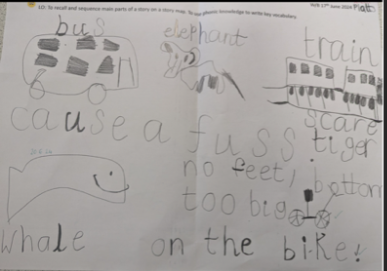
Some super writing from the children in the Enhanced Provision based on the picture book "You can't let an elephant on a bus!":
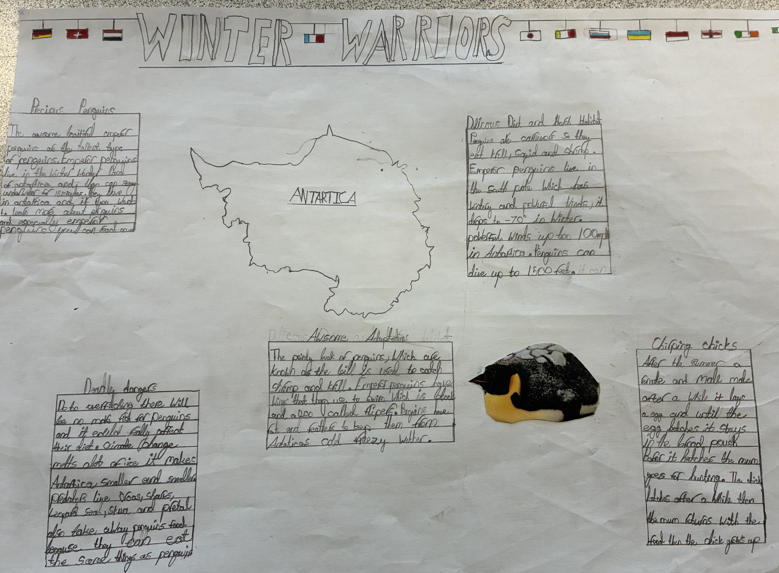
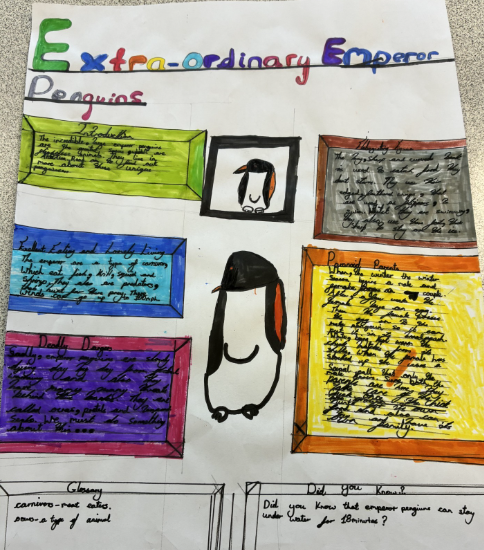
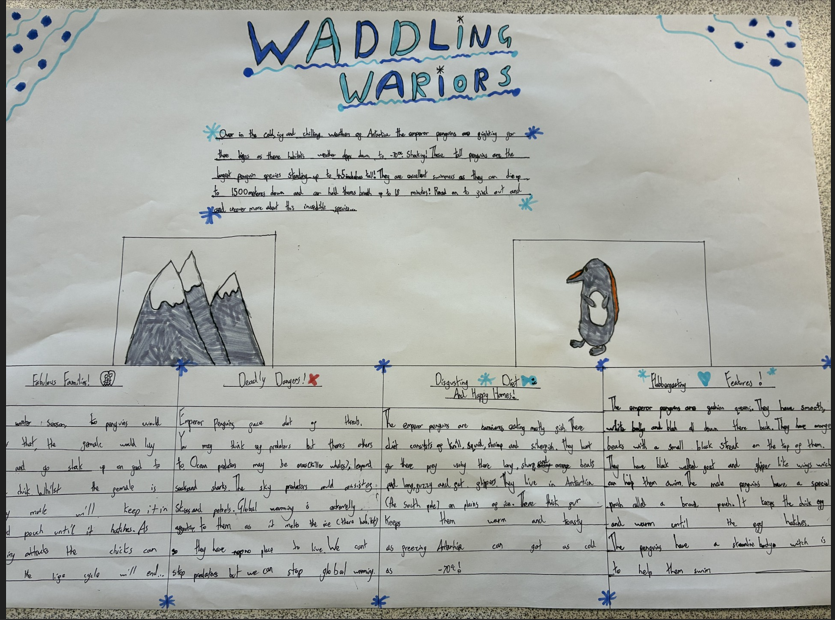
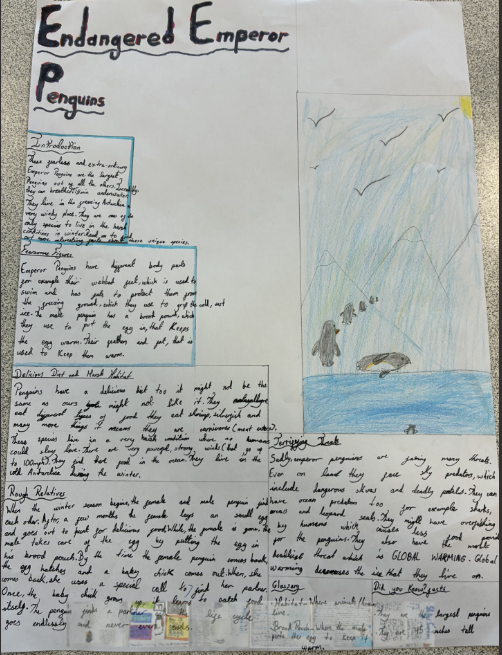
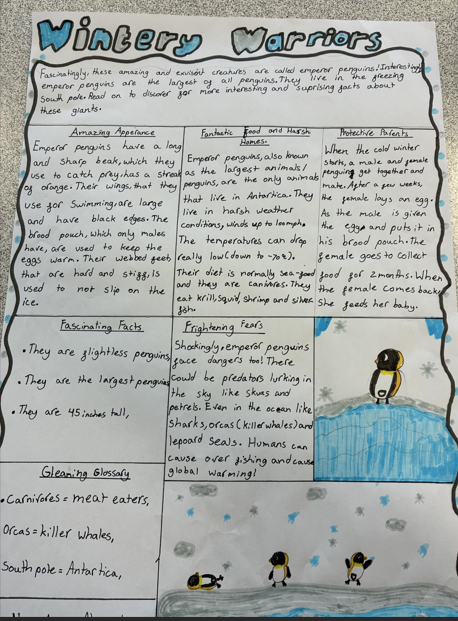
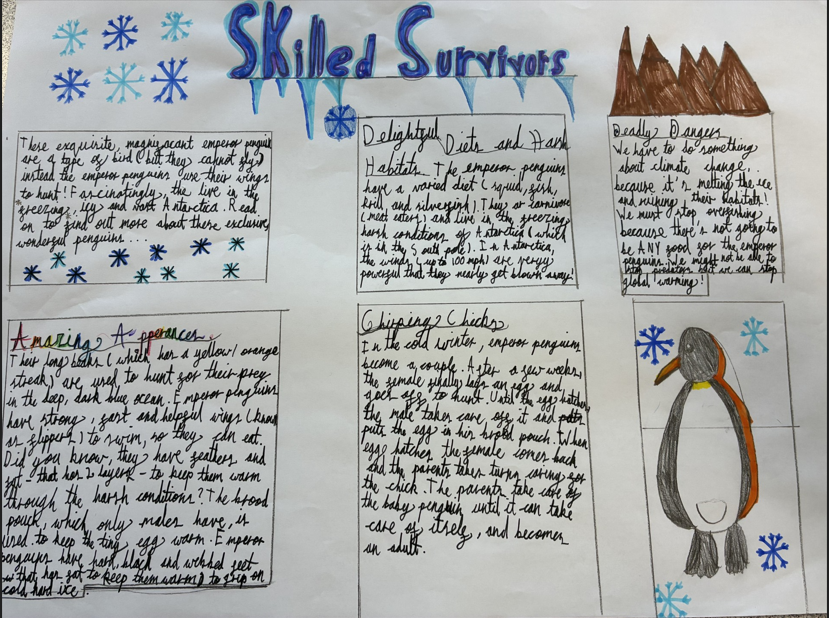
Some excellent writing from children in Year 5 based on a non-chronological report on Emperor Penguins. Fabulous presentation and some very interesting facts too:
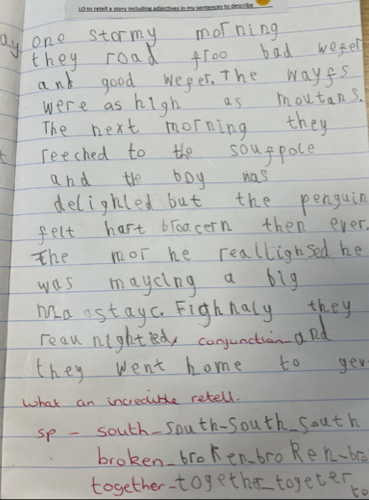
An excellent retell of the story 'Lost and Found' by our talented year 1 children.
Spelling
Intent
At Nottingham Academy Primary, teachers will show pupils how to understand the relationships between words, how to understand the nuances of meaning, and how to develop their understanding of and ability to spell a wide range of words. They will also teach pupils how to work out and clarify the meanings of unknown words and words with more than one meaning.
Our approach to spelling:
- Develops the children’s understanding of word meaning to unlock wider comprehension.
- Allows children to make links between prior knowledge and builds on the foundations of phonics laid down in the Early Years.
- Provides the children with the opportunity to experiment and build words, as well as expand their vocabulary bank.
Implementation
We start teaching phonics in Nursery with Foundation for Phonics and begin daily Little Wandle Letters and Sounds Revised lessons in Reception and Year 1, which ensures children build on their growing knowledge of the alphabetic code, mastering phonics to read and spell as they move through school. As a result, we aim for all our children to be able to tackle any unfamiliar and decodable words as they read and spell. We have a strong focus on language development for our children because we know that speaking and listening are crucial skills for reading and writing in all subjects.
In Year 2, the children have daily Little Wandle spelling sessions which follow a similar structure to Little Wandle phonics, supporting children to make links to their phonic learning and helping them to accurately spell common exception words. Little Wandle spelling teaches children to consider etymology, morphology and grammar when spelling new words.
From Year 3 onwards, we continue to build on the children’s understanding of the etymology and introduce them to the morphology of words (how words are structured and related to one another by a combination of form, grammar and meaning). This approach allows us to build on the foundations that have already been put in place in Key Stage 1 and allows for a more seamless transition between spelling strategies when moving between key stages. Where words are irregular, and do not follow the rules, we continue to use etymology (the stories behind the spelling of certain words) and graphic strategies to help children to learn these spellings. Spelling lessons take place 3 times-a-week and allow the children to immerse themselves in their new spelling prefix, suffix or root word, thus allowing them to form links between words and prior learning.
Handwriting- Kinetic letters programme
Intent:
At Nottingham Academy, we believe in the importance of all children being able to write with ease, speed and legibility to support their learning across the curriculum. Handwriting is a movement skill which, like reading and spelling, affects levels of written communication. Therefore, we ensure that this is taught explicitly through the Kinetic Letters handwriting programme. This programme was launched in January 2026 with our EYFS and Y1 pupils, with Year 2 joining the programme at the beginning of the Summer term. As of September 2026, the programme will build through into KS2. Please see the Kinetic letters handwriting policy below.
Implementation:
The Kinetic letters programme has four Threads.
-
- Making bodies stronger
- Holding the pencil (for speed, comfort and legibility)
- Learning the letters
- Flow and fluency
The key principles of the Kinetic letters programme are:
-
- Building physical strength underpins handwriting and concentration. This knowledge informs the working positions that children use for writing and the strengthening targets they work on.
- Pupils are not expected to do anything before they are developmentally ready for it.
- The different components of writing are mastered individually before being used in combination.
- Letters are learnt as movements, not as visual shapes, and movement remains central to developing automaticity in letter formation, flow and fluency.
- Posture is important in developing the correct position for handwriting and so children are taught how to organise their working position and paper position to enable comfortable and fluent writing from the start.
- Correct pencil hold is taught from the start (ie as soon as a tripod grip is developmentally appropriate), and the strength is developed to maintain this, enabling comfort, speed and writing stamina.
Handwriting practice takes place in sessions that are outside English lessons, since handwriting underpins the majority of curriculum areas and is integral to self-esteem and engagement with learning. Handwriting is taught in discrete sessions, separate from Phonics, and achieves Fidelity with the Reading Framework (2023).
Pupils in EYFS and KS1 do daily handwriting sessions of at least 20 minutes. Thereafter time allocation to maintain handwriting development and increase speed and flow, will be regular but at the discretion of the class teacher so long as appropriate progression continues to be made.
Handwriting practice takes place on the 6-lined (or 3-lined or 9-lined if appropriate) Kinetic Letters white boards, supported by visits to Sand Trays, with a transition to books via the ‘Practice Patch’.
The majority of the time, sessions are taught to the whole class with differentiation enabled Kinetic Letters strategies and resources. Reinforcement may take place in small groups and/or individually.
Strategies to build physical strength for handwriting are integrated into general school life and provision for EYFS.